Showing posts with label Pre-nuptial agreements. Show all posts

Friday, December 23, 2016

Prenuptial Agreements Should Address All Terminating Events For A Marriage

 Every marriage will come to an end.   Some terminate by divorce and others terminate by death.   Eventually every marriage will end.  

Most people who want Prenuptial Agreements  (also called premarital agreements or prenups) want the agreement for protection in the event of a divorce.   However, a recent case in Massachusetts explained that a well drafted agreement should also address termination by death.  

In the case of Stacy v Stacy the husband and wife had a Prenuptial agreement that had the following language:  "a final and complete settlement of all matters relating to the interest and obligations of each [party] with respect to all future property matters, including but not limited to alimony, support, maintenance, property assignment, and the rights of the parties under G. L. c. 208, § 34, as amended, in the event of a divorce."  Apparently the agreement was silent on what was to happen if a spouse died.   

The husband died and the personal representative of his estate sued his widow over ownership of personal property.  The Appeals Court held that the language of the agreement did not exclude applicability to other events such as death.  This meant that the personal representative and the widow had to try a case to figure out how to interpret the agreement.  Most people who draft prenuptial agreements do so to avoid litigation.  This agreement failed to do so.

A properly drafted prenuptial agreement should specifically address termination of the marriage by both marriage and death.  If the parties don't want to include events other than divorce then the agreement should state so in clear language.   In the Stacy case they could have included a sentence to the effect of "in the event this marriage terminates by death this agreement shall have no effect and shall not decrease the rights of the surviving spouse."

If you are considering a prenuptial agreement you should consult an experienced family law attorney to draft an agreement that includes provisions for termination by death and by divorce.

Monday, February 9, 2015

Pre-Nuptial Agreements are not automatically enforced.

Pre-Nuptial Agreements are not automatically enforced.

Pre-nuptial agreements in Massachusetts are enforced if they are fair at the time of the execution of the agreement and fair at the time of the enforcement of the agreement. Fairness at the time of the execution means that there was complete financial disclosure, had the ability to obtain advice of counsel, the agreement was free of duress, misrepresentation, and fraud and the terms are fair. Since the agreement must also be fair at the time of enforcement, the Courts take a “second look” at the agreement and view it in the context of the financial circumstances at that time. The agreement will be enforced unless the court finds that it is unconscionable. This means that the agreement will be enforced unless the agreement would leave the contesting spouse without sufficient property, maintenance, or appropriate employment to support herself.

In a recent case, Kelcourse v.Kelcourse, Mass.App.Ct. (Jan. 21, 2015), the court refused to enforce a pre-nuptial agreement. The agreement on its face appeared fair. The agreement gave the
Wife a house and alimony as part of the settlement. The problem was that the house needed over $300,000.00 in repairs and had negative equity. The Wife lacked funds to repair the house and, due to the negative equity, was unable to sell the house. The Court found that the condition and finances of the house rendered the agreement unconscionable and unenforceable.


The Kelcourse case means that in Massachusetts the second look is a real and substantial examination. The Court won't enforce the agreement if the spouse won't be able to support herself. In other words, disclosure and lack of duress is not enough to make an agreement enforceable. The second look must examine the circumstances to see if the facts and enforcement would shock the conscience.

If parties want a pre-nuptial agreement they should consult family law attorneys to advise them. This is not an area where parties should do-it-yourself. When the parties seek to enforce the agreement it may be too late to fix any problems.


Thursday, January 2, 2014

Should a Stay-At-Home parent have a post-nuptial agreement?

A person who chooses to stay at home to raise children usually makes this decision after consultation with their spouse. The decision is made in furtherance of the partnership called a marriage. The stay-at-home parent assumes that the marriage will last until one of the parties dies and that they won't suffer financially as a result of leaving the work force. Unfortunately, many marriages are terminated by divorce and the stay-at-home parent finds themselves unable to maintain their standard of living after divorce.

When a stay-at-home parent returns to the work force after years of child raising they frequently find that they are considered unqualified for their former occupation. They may need to return to school to refresh their skills. When they do find work, they frequently start with entry positions instead of a job comparable to their peers who never left their occupations.

Prior to 2011, divorce judges frequently compensated such stay-at-home parents with alimony awards designed to maintain their standard of living. However, in 2012 Massachusetts enacted an alimony reform law that can result in loss of security for the stay-at-home parent. The alimony reform law contains, among other provisions,1) a limitation preventing the award of alimony if child support is paid and the combined income of the parties is less than $250,000.00; 2) time limits for the period of alimony when alimony is granted; and 3) a termination of alimony at retirement age. Given the changes due to the alimony reform law, it is wise to plan for the potential of a divorce.

An agreement between the spouses can provide security for the stay-at-home spouse despite the changes caused by the alimony reform law. If the parties create such an agreement before marriage, it is called a pre-nuptial agreement. Many couples don't anticipate such situation before marriage. There is an alternative: a post-nuptial agreement. A post-nuptial agreement is an agreement between the spouses that is like a pre-nuptial except that it is executed after marriage. Massachusetts has joined the growing number of states that allow post-nuptial agreements in some circumstances. An agreement between the spouses which results in one spouse leaving the work force to raise children should be valid as a post-nuptial agreement in Massachusetts.

A person who is contemplating leaving work to raise children should consult an experienced lawyer about a pre-nuptial or post-nuptial agreement to compensate them for the anticipation of not working as a result of their decision.

Source: Dostay-at-home moms need a 'postnup'?” by Jeff Landers published at Today.com


Monday, May 28, 2012

Islamic marriage contract (Sadaq) and divorce.

     Divorce in this country occurs in all cultures and religions and Islamic couples are not immune from divorce. A divorce in Florida reportedly raises unusual issues because of a traditional Islamic custom called a Sadaq. A Sadaq is a marriage contract in which it is traditional for the groom to promise a marriage gift to the bride.
     In the divorce between Farah Shamsi and her husband Abdul, the gift was a $20,000.00 dowry which at the time of the divorce had not been paid. The wife claimed that it had to be paid at the time of the divorce.
     In Massachusetts, a Sadaq will be treated the same as any other pre-nuptial agreement. Massachusetts requires that pre-nuptial agreements must be fair at the time of contract and fair at the time of enforcement or they are invalid. The court will examine the entire contract to determine validity. Clauses that prohibit divorce will not be enforced and may render the entire contract invalid. The court will look at the intentions of the parties when they signed the contract. The court will examine the financial disclosures provided at the at the time of the execution of the contract. The court will also look at the total circumstances at the time of the divorce. The enforcability of the Sadaq will be determined by Massachusetts law and not by Islamic law as part of the divorce proceeding.
     The same approach will be taken with other traditional marriage contracts such as a Jewish Ketubah. They will all be enforced according to Massachusetts law.

Sunday, September 25, 2011

Who should have a premarital agreement?

The simple answer is anybody who comes to the marriage with something to protect when the marriage terminates should have a premarital agreement when they get married. The general categories of people who can benefit are people with children from a prior relationship, significant family assets, or people who own a business which comprises a major source of income.
If there are children from a prior relationship, they may not inherit when their parent dies without a premarital agreement. The laws of inheritance give preference to a surviving spouse. Even if a will exists, the law still gives preference to a spouse. The best way to make sure that children can inherit is to write a prenuptial agreement. When one spouse owns a business or a portion of the business in which they receive significant income, it may be desirable to make certain that the new spouse can't receive a portion of the business in a divorce. It can be devastating to the business to have a person own a business when they are not qualified to run the business. It can also be very difficult for one spouse to suddenly work for an ex-spouse.

Another group of people who should have a premarital agreement are people who are religious and whose religion offers a religious termination of a marriage.  Catholics, Muslims, and Jews can all obtain a religious decision that a marriage is terminated or never existed.  Some people will want both a secular divorce and a religious divorce or annulment.  Anyone in this group can benefit from a premarital agreement because an agreement can make a religious termination occur without a fight and at minimal cost.

Premarital agreements can successfully protect against these problems and others.  Consulting an experienced family law attorney before getting married can eliminate problems and fighting when the marriage terminates.

Sunday, September 18, 2011

What is a pre-nuptial agreement?

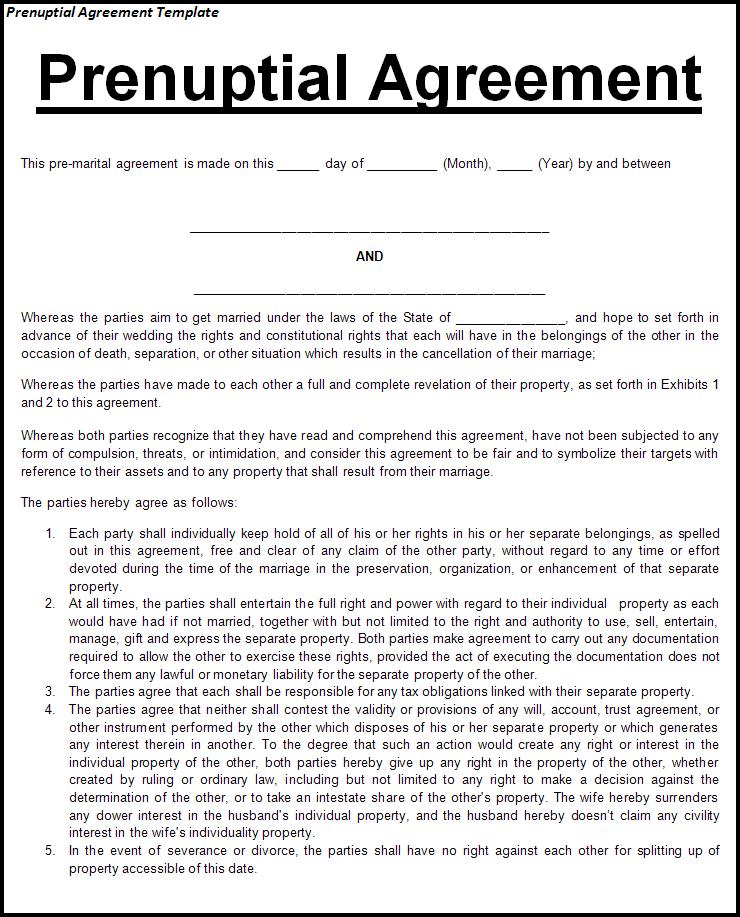
A pre-nuptial agreement is an agreement between a couple who intend to get married which determines financial obligations upon termination of the marriage. All marriages terminate either by divorce or by death. A pre-nuptial agreement should determine rights and obligations for both methods of termination. A pre-nuptial agreement must be fair at the time of creation and fair at the time of enforcement. Fairness at the time of creation means that both parties must make a full and fair disclosure of their income, assets, expenses, and liabilities. Fairness at the time of enforcement requires a fair distribution of income and assets at the time of termination. This doesn't mean an equal distribution but one party can't be left destitute. As parties can't contract away children's rights, a pre-nuptial agreement can't determine child custody or support issues.

An experienced family law attorney can help avoid problems upon termination of the marriage.